
ResearchWhich RC specification should you use?
Which RC specification should you use?
Two published figures can disagree without either telling you what is installed in your particular car. Work from identity and evidence before choosing a number.
Published . Reference figures are a dated catalog snapshot; linked sheets carry the sources and subsequent corrections.
Check whether the documents describe the same car
Before choosing a number, compare the model code, revision and configuration in each source. A manual can cover several variants, a parts list can include optional gears, and a product page can summarize a family. Two values are only a useful contradiction when they refer to the same thing.
Keep both values with the document title, page, revision and URL. Writing down the disagreement prevents a later search result from replacing the evidence you actually checked.
A worked example: the Stampede total ratio
For the Stampede 2WD BL-2s 36354-4, the product-page reference gives a 2.72 internal reduction and a 12.34:1 final drive. The model’s manual and parts list support a 21T pinion and 90T spur, which calculate to 11.66:1 instead.
Keep the source, the value and the inference separate
Scroll sideways to see all columns.
| Evidence | Value | What it establishes |
|---|---|---|
| Product-page reference | 2.72 internal; 12.34 final | A published total to investigate |
| Manual gearing chart, page 25 | 21T / 90T; 11.66:1 | A documented gear combination |
| Parts-list reference | 2421 pinion; 4690 spur | Ordering identities for the listed gears |
| Arithmetic | 90 ÷ 21 × 2.72 = 11.657… | The three inputs agree with about 11.66:1 |
The manual, pages 24 and 25 (opens in a new tab), gives the formula and gearing chart. Check the parts list (opens in a new tab) and its stock-versus-option formatting alongside it. These documents support a specific reference configuration; counting the installed gears establishes what is in your own truck.
Using 11.66 rather than 12.34 gives about 5.9% more ideal wheel speed at the same motor RPM. That is large enough to matter when comparing calculations. It still does not explain the origin of the conflicting total, or prove that every truck sold under the name has your installed setup.
Choose evidence for the question you are answering
- “What was supplied?” Start with exact-model documents that identify the original configuration and distinguish optional equipment.
- “What is installed now?” Inspect markings, count teeth and document modifications. Your car can differ legitimately from the factory specification.
- “What should I order?” Match the assembly, part number, mounting details and manufacturer compatibility information.
- “What should I put in the calculator?” Use supported installed values and label any remaining estimate.
A source is strong when it directly addresses the question and exact configuration. A newer product page does not automatically settle an older revision, and several retailer pages repeating one value are not necessarily independent confirmations.
Arithmetic is a check, not another measurement
If you derive internal reduction by dividing published final drive by the spur-to-pinion ratio, recalculating final drive from that result returns the original total by construction. It has not independently verified the transmission.
The same problem appears when an unknown tire diameter or KV rating is adjusted until the calculator matches an advertised speed. The match is an assumption used to fit the answer, not evidence that the input is correct. Keep the original uncertainty and find a part specification, measurement or exact-model document that can resolve it.
Small rounding differences deserve a different response from different gear choices. Keep extra digits while calculating, round the displayed answer at the end, and inspect the underlying inputs before treating the last decimal as a component difference.
Make a correction that someone else can verify
- Name the exact model and field. Include the SKU and the page you are reporting.
- Show both values. State the current reference and the proposed correction.
- Link the evidence. Give the manual page, product URL or clear photograph of the installed part number.
- Explain the scope. Say whether this is a factory-specification correction, a revision difference or a modification to your own car.
- Leave anything unresolved explicit. A useful report can identify a conflict without claiming to have settled it.
For example: “Stampede 36354-4, final drive: the product reference says 12.34:1. The manual chart on page 25 gives 21T/90T and 11.66:1; 90 ÷ 21 × 2.72 agrees. I have not inspected an unmodified example.” That is enough to review the documentary conflict without implying a physical test.
Use the feedback form or the corrections address below. Include the evidence in the report so another owner can follow the reasoning.
Reference sheets
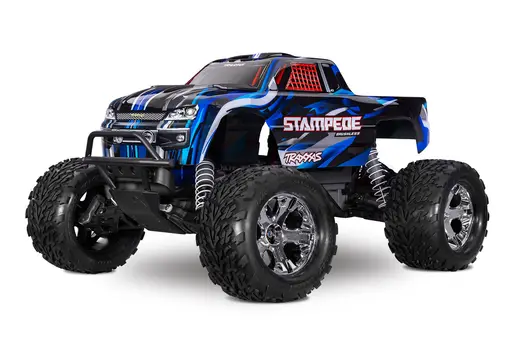 Traxxas Stampede 2WD BL-2sOpen the sourced specification sheetPhoto: Traxxas
Try it with your model
Loading a vehicle changes the working setup shared by the car calculators. Save your current setup first if you want to keep it.
Sources and corrections
Reference figures above come from the linked vehicle sheets and their manufacturer documents. No hands-on fitment or speed test is claimed. For the evidence standard, see Methodology. Send a correction with the exact model and source to hello@rctunelab.com.