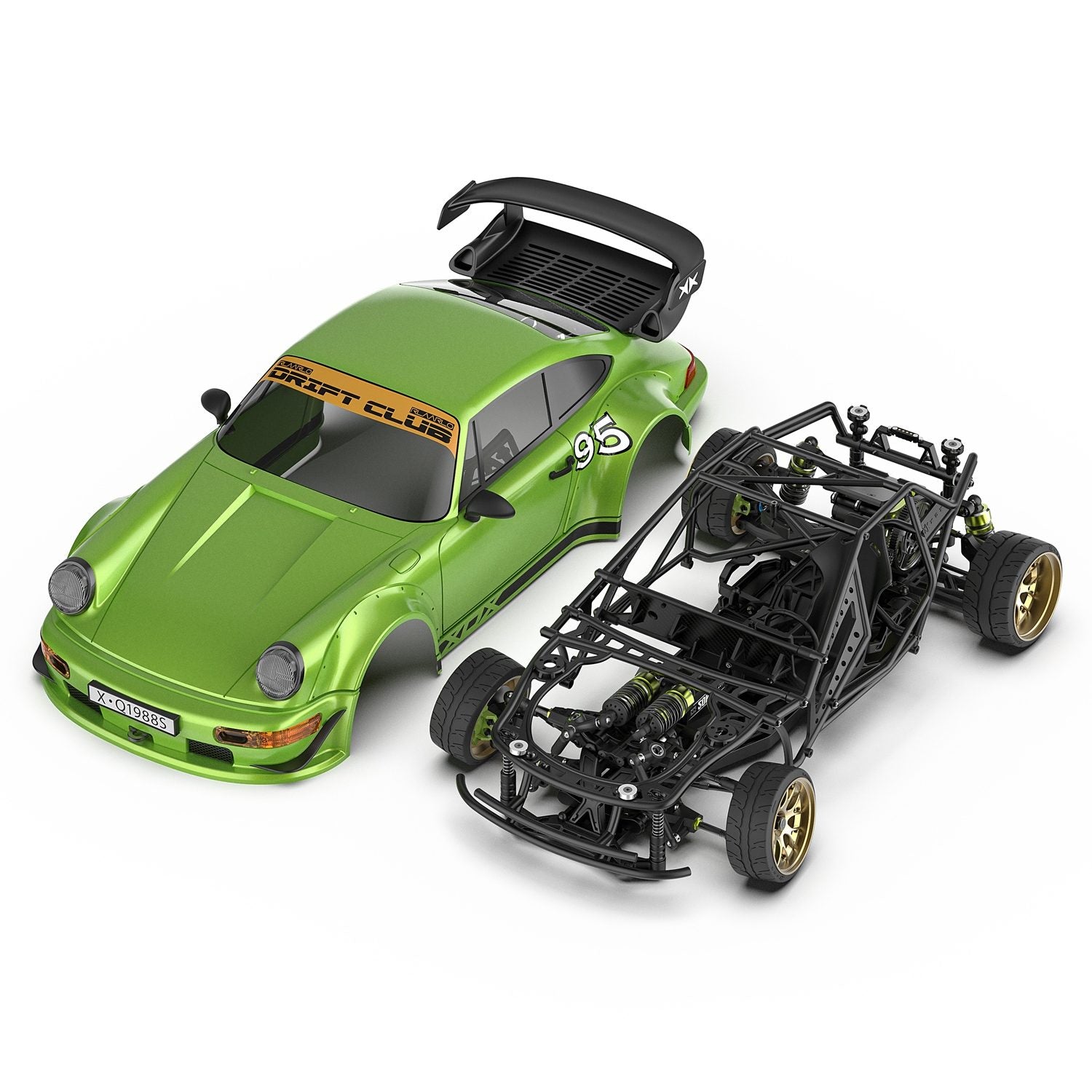
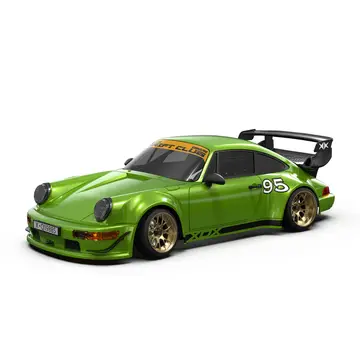
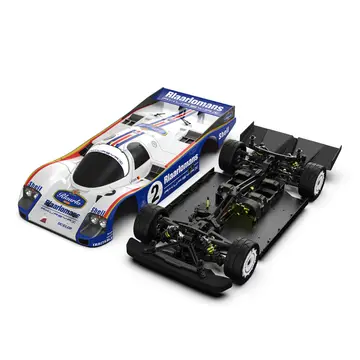
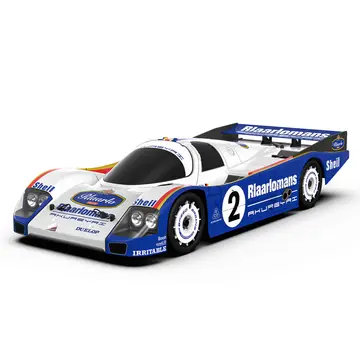
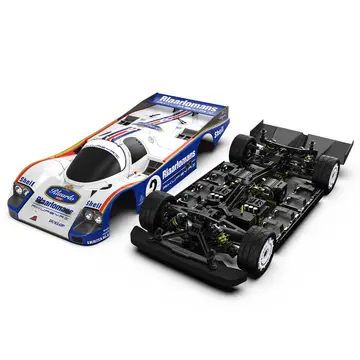
The XDX-964 is Rlaarlo’s fourth-generation rear-drive drift chassis with the 964 coupe bodywork. The platform uses angled steering, threaded horizontal dampers and an adjustable layout. Its self-locking differential has interchangeable springs so a driver can adapt the way the rear wheels drive together. Model reference (opens in a new tab)
Read moreShow less
The roller supplies the mechanical platform and body, with the electronics left to the builder. The matching RTR gives a factory example of how the chassis can be equipped. Rlaarlo publishes the two body dimensions independently, so check the shell before setting wheelbase and track width. Technical reference (opens in a new tab)
The kind of vehicle the maker sells it as. It sets what the car is built to do and which cars it is fair to compare it with.
Drift cars are set up to slide through corners on hard plastic tires, with the rear wheels turning faster than the front or driven alone.
Drive
Only the rear wheels are driven.
Modern drift chassis are mostly rear-wheel drive and use a steering gyro to hold the car at an angle through a slide.
Power
Sold without a motor, so you choose the motor, ESC and battery yourself.
Rows that depend on the motor say so.
Build
Almost ready to run: built at the factory but missing some electronics, usually the radio and sometimes the motor, ESC or servo.
Scale
The maker's nominal size compared with a full-size vehicle. It works more as a class label than a measurement.
A 1/10 monster truck is far bigger than a 1/10 touring car, so compare length and weight for real size.
This one is 485 mm long.
Part number
The maker's product number for this exact version.
A V2, a new color, or a kit instead of an RTR usually has a different number, and parts can differ between them.
Check it against your box or receipt before ordering parts.
Class
Drift
Drive
2WD
Power
Motor not included
Build
Roller / ARR
Scale
1/10
Part number
XDX-964-Roller
Drivetrain
Pinion
The small gear on the motor shaft. Fewer teeth gear the car shorter: quicker acceleration, lower top speed and a cooler motor. More teeth do the opposite.
On this car one tooth changes the gearing by about 4.3%.
A bigger pinion loads the motor and ESC harder, so check the maker's gearing chart and feel the motor temperature after a run.
Spur
The large gear the pinion drives. A bigger spur with the same pinion gears the car shorter.
Pinion and spur need matching pitch, or explicit manufacturer confirmation that the exact gears are compatible.
The Gearing parts table below shows this car's pitch and part numbers.
Transmission & axle
Every reduction after the spur, multiplied together: transmission, differentials and axle gears.
It is fixed by the design; the gearing you change is the pinion and spur.
On a belt-driven drift chassis it takes in the pulley ratios as well.
Final drive
How many times the motor turns for one turn of the wheels. A higher number is shorter gearing: more acceleration and pulling power, less top speed.
Drift cars are geared for fine throttle control through a slide more than for top speed.
Differentials
The type of each differential, as the maker states it.
A gear or ball diff lets the wheels on one axle turn at different speeds in a corner; a spool or locked diff turns them together for straight-line drive and climbing, at the cost of steering.
A limited-slip diff sits between the two: it lets the wheels differ, but only so far.
Pinion pitch
The tooth spacing of the fitted gear, stated as metric module or diametral pitch.
Pinion and spur need matching pitch or explicit manufacturer confirmation of compatibility for the exact parts. Mod 0.8 and 32P are different standards; a compatibility statement for particular gears does not apply to every gear. A missing pitch can be inferred from the other fitted gear; module and diametral pitch are not silently converted.
Spur pitch
The tooth spacing of the fitted gear, stated as metric module or diametral pitch.
Pinion and spur need matching pitch or explicit manufacturer confirmation of compatibility for the exact parts. Mod 0.8 and 32P are different standards; a compatibility statement for particular gears does not apply to every gear. A missing pitch can be inferred from the other fitted gear; module and diametral pitch are not silently converted.
The outside diameter of the mounted tire, tread to tread. A taller tire covers more ground each turn, which gears the car taller.
Drift tires are hard plastic and barely change size as they wear, so the gearing stays put.
Stock tire width
Stock tire width: A documented stock wheel, tire, or axle measurement. Stock dimensions alone do not establish the largest size that will clear the body and suspension.
What the shocks are and how they are built, as the maker describes them.
Oil-filled shocks damp with silicone oil; friction shocks, found on some entry-level cars, damp with a sprung plunger and cannot be tuned with oil.
Threaded bodies set ride height with a collar you turn, rather than clips.
Shock length
The stated length of the complete shock assembly. Sources may use mounting-eye centers or a nominal assembly length.
Compare fully extended mounting-eye spacing, compressed length and mounting hardware before ordering. A longer shock changes ride height and travel, and can bind at full droop or bottom out.
Compressed length
The shock's length eye to eye when fully compressed.
The gap between this and the extended length is the travel the shock allows.
Shock oil
The oil in the shocks slows how fast the suspension moves. Thicker oil settles the car more slowly and resists bottoming out; thinner oil lets the wheels follow bumps.
Front and rear run the same oil on this car, so both ends respond alike. Changing one end at a time is the usual way to shift the balance.
This is the maker's printed oil grade. Its viscosity unit has not been established, so it is not presented as cSt or cps. Grade numbers alone do not establish equivalent oils or relative thickness.